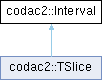
Interval class, for representing closed and connected subsets of \(\mathbb{R}\). More...
#include <codac2_Interval.h>
Public Member Functions | |
| Interval () | |
| Creates an interval \([-\infty,\infty]\). | |
| Interval (double a) | |
| Creates a degenerate interval \([a,a]\), \(a\in\mathbb{R}\). | |
| Interval (double a, double b) | |
| Creates an interval \([a,b]\), \(a\in\mathbb{R}, b\in\mathbb{R}\). | |
| Interval (const Interval &x) | |
| Creates an interval from another one. | |
| Interval (const std::array< double, 1 > &array) | |
| Create an interval \([a,a]\) from a fixed-sized array of size 1. | |
| Interval (const std::array< double, 2 > &array) | |
| Create an interval \([a,b]\) from a fixed-sized array of size 2. | |
| Interval (std::initializer_list< double > l) | |
| Create an interval as the hull of a list of values. | |
| Interval & | init () |
| Sets the value of this interval to [-oo,oo]. | |
| Interval & | init (const Interval &x) |
| Sets the value of this interval to x. | |
| Interval & | init_from_list (const std::list< double > &l) |
| Sets the bounds as the hull of a list of values. | |
| Interval & | operator= (double x) |
| Sets this to x. | |
| Interval & | operator= (const Interval &x) |
| Sets this to x. | |
| bool | operator== (const Interval &x) const |
| Comparison (equality) between two intervals. | |
| bool | operator!= (const Interval &x) const |
| Comparison (non equality) between two intervals. | |
| BoolInterval | operator< (const Interval &x) const |
| Comparison (strict less-than) between this and x. | |
| BoolInterval | operator> (const Interval &x) const |
| Comparison (strict greater-than) between this and x. | |
| double | lb () const |
| Returns the lower bound of this. | |
| double | ub () const |
| Returns the upper bound of this. | |
| double | mid () const |
| Returns the midpoint of this. | |
| double | mag () const |
| Returns the magnitude of this i.e. max(|lower bound|, |upper bound|). | |
| double | mig () const |
| Returns the mignitude of this. | |
| double | smag () const |
| Returns the signed magnitude of this i.e. lower bound if |lower bound|>|upper bound|, upper bound otherwise. | |
| double | smig () const |
| Returns the signed mignitude of this. | |
| double | rand () const |
| Returns a random value inside the interval. | |
| double | rad () const |
| Returns the radius of this. | |
| double | diam () const |
| Returns the diameter of this. | |
| double | volume () const |
| Returns the diameter of this. | |
| Index | size () const |
| Returns the dimension of this (which is always ). | |
| void | set_empty () |
| Sets this interval to the empty set. | |
| bool | is_empty () const |
| Tests if this is empty. | |
| bool | contains (const double &x) const |
| Tests if this contains x. | |
| bool | interior_contains (const double &x) const |
| Tests if the interior of this contains x. | |
| bool | is_unbounded () const |
| Tests if one of the bounds of this is infinite. | |
| bool | is_degenerated () const |
| Tests if this is degenerated, that is, in the form of \([a,a]\). | |
| bool | is_integer () const |
| Tests if this is an integer, that is, in the form of \([n,n]\) where n is an integer. | |
| bool | has_integer_bounds () const |
| Checks whether the interval has integer lower and upper bounds. | |
| bool | intersects (const Interval &x) const |
| Tests if this and x intersect. | |
| bool | is_disjoint (const Interval &x) const |
| Tests if this and x do not intersect. | |
| bool | overlaps (const Interval &x) const |
| Tests if this and x intersect and their intersection has a non-null volume. | |
| bool | is_subset (const Interval &x) const |
| Tests if this is a subset of x. | |
| bool | is_strict_subset (const Interval &x) const |
| Tests if this is a subset of x and not x itself. | |
| bool | is_interior_subset (const Interval &x) const |
| Tests if this is in the interior of x. | |
| bool | is_strict_interior_subset (const Interval &x) const |
| Tests if this is in the interior of x and different from x. | |
| bool | is_superset (const Interval &x) const |
| Tests if this is a superset of x. | |
| bool | is_strict_superset (const Interval &x) const |
| Tests if this is a superset of x and different from x. | |
| Interval & | inflate (const double &rad) |
| Adds [-rad,+rad] to this. | |
| bool | is_bisectable () const |
| Tests if this can be bisected into two non-degenerated intervals. | |
| std::pair< Interval, Interval > | bisect (float ratio=0.49) const |
| Bisects this into two subintervals. | |
| std::vector< Interval > | complementary (bool compactness=true) const |
| Computes the complementary of this. | |
| std::vector< Interval > | diff (const Interval &y, bool compactness=true) const |
| Computes the result of \([x]\backslash[y]\). | |
| Interval & | operator|= (const Interval &x) |
| Self union of this and x. | |
| Interval & | operator&= (const Interval &x) |
| Self intersection of this and x. | |
| Interval & | operator+= (double x) |
| Self addition of this and a real x. | |
| Interval & | operator+= (const Interval &x) |
| Self addition of this and x. | |
| Interval | operator- () const |
| Substraction of this. | |
| Interval & | operator-= (double x) |
| Self substraction of this and a real x. | |
| Interval & | operator-= (const Interval &x) |
| Self substraction of this and x. | |
| Interval & | operator*= (double x) |
| Self multiplication of this and a real x. | |
| Interval & | operator*= (const Interval &x) |
| Self multiplication of this and x. | |
| Interval & | operator/= (double x) |
| Self division of this and a real x. | |
| Interval & | operator/= (const Interval &x) |
| Self division of this and x. | |
Static Public Member Functions | |
| static Interval | empty () |
| Provides an empty interval. | |
| static Interval | zero () |
| Provides an interval for \([0]\). | |
| static Interval | one () |
| Provides an interval for \([1]\). | |
| static Interval | half_pi () |
| Provides an interval for \([\frac{\pi}{2}]\). | |
| static Interval | pi () |
| Provides an interval for \([\pi]\). | |
| static Interval | two_pi () |
| Provides an interval for \([2\pi]\). | |
Detailed Description
Interval class, for representing closed and connected subsets of \(\mathbb{R}\).
The class also encapsulates the interval representation provided by the Gaol library.
This class reuses several functions developed for ibex::Interval. See ibex::Interval (IBEX lib, main author: Gilles Chabert) https://ibex-lib.readthedocs.io
Constructor & Destructor Documentation
◆ Interval() [1/6]
|
inline |
Creates a degenerate interval \([a,a]\), \(a\in\mathbb{R}\).
- Parameters
-
a single value contained in the resulting interval
◆ Interval() [2/6]
|
inline |
Creates an interval \([a,b]\), \(a\in\mathbb{R}, b\in\mathbb{R}\).
- Parameters
-
a lower bound of the interval b upper bound of the interval
◆ Interval() [3/6]
|
inline |
Creates an interval from another one.
- Parameters
-
x the interval to be copied
◆ Interval() [4/6]
|
inlineexplicit |
Create an interval \([a,a]\) from a fixed-sized array of size 1.
- Parameters
-
array the array of doubles
◆ Interval() [5/6]
|
inlineexplicit |
Create an interval \([a,b]\) from a fixed-sized array of size 2.
- Parameters
-
array the array of doubles
◆ Interval() [6/6]
|
inline |
Create an interval as the hull of a list of values.
- Parameters
-
l list of values contained in the resulting interval
Member Function Documentation
◆ init() [1/2]
|
inline |
Sets the value of this interval to [-oo,oo].
- Note
- This function is used for template purposes.
- Returns
- a reference to this
◆ init() [2/2]
Sets the value of this interval to x.
- Note
- This function is used for template purposes.
- Parameters
-
x the value for re-initialization
- Returns
- a reference to this
◆ init_from_list()
|
inline |
Sets the bounds as the hull of a list of values.
- Note
- This function is separated from the constructor for py binding purposes.
- Parameters
-
l list of values contained in the resulting interval
- Returns
- a reference to this
◆ operator=() [1/2]
|
inline |
Sets this to x.
- Parameters
-
x real to be intervalized
- Returns
- a reference to this
◆ operator=() [2/2]
Sets this to x.
- Parameters
-
x interval to be copied
- Returns
- a reference to this
◆ operator==()
|
inline |
Comparison (equality) between two intervals.
- Parameters
-
x interval to be compared with
- Returns
- true iff this and x are exactly the same intervals
◆ operator!=()
|
inline |
Comparison (non equality) between two intervals.
- Parameters
-
x interval to be compared with
- Returns
- true iff this and x are not exactly the same intervals
◆ operator<()
|
inline |
Comparison (strict less-than) between this and x.
The returned BoolInterval encloses the truth value of \(t<s\) for \(t\in[\mathrm{this}]\) and \(s\in[x]\).
- Note
- Returns:
- BoolInterval::EMPTY if this or x is empty
- BoolInterval::TRUE iff \(\mathrm{ub}([\mathrm{this}])<\mathrm{lb}([x])\)
- BoolInterval::FALSE iff \(\mathrm{ub}([x])\leq\mathrm{lb}([\mathrm{this}])\)
- BoolInterval::UNKNOWN otherwise
- Parameters
-
x interval to be compared with
- Returns
- interval Boolean result
◆ operator>()
|
inline |
Comparison (strict greater-than) between this and x.
The returned BoolInterval encloses the truth value of \(t>s\) for \(t\in[\mathrm{this}]\) and \(s\in[x]\).
- Note
- Returns:
- BoolInterval::EMPTY if this or x is empty
- BoolInterval::TRUE iff \(\mathrm{lb}([\mathrm{this}])>\mathrm{ub}([x])\)
- BoolInterval::FALSE iff \(\mathrm{lb}([x])\geq\mathrm{ub}([\mathrm{this}])\)
- BoolInterval::UNKNOWN otherwise
- Parameters
-
x interval to be compared with
- Returns
- interval Boolean result
◆ lb()
|
inline |
Returns the lower bound of this.
- Returns
- lower bound
◆ ub()
|
inline |
Returns the upper bound of this.
- Returns
- upper bound
◆ mid()
|
inline |
Returns the midpoint of this.
- Note
- The return point is guaranteed to be included in this but not necessarily to be the closest floating point from the real midpoint. In particular, cases are:
- [empty] -> Quiet NaN
- [-oo,+oo] -> mid = 0.0
- [-oo,b] -> mid = -MAXREAL
- [a,+oo] -> mid = MAXREAL
- [a,b] -> mid ~ a + .5*(b-a)
- Returns
- midpoint
◆ mag()
|
inline |
Returns the magnitude of this i.e. max(|lower bound|, |upper bound|).
- Returns
- the magnitude of the interval
◆ mig()
|
inline |
Returns the mignitude of this.
+(lower bound) if lower_bound > 0 -(upper bound) if upper_bound < 0 0 otherwise.
- Returns
- the mignitude of the interval
◆ smag()
|
inline |
◆ smig()
|
inline |
Returns the signed mignitude of this.
lower bound if lower_bound > 0, upper bound if upper_bound < 0, 0 otherwise.
- Returns
- the signed mignitude of the interval
◆ rand()
|
inline |
Returns a random value inside the interval.
- Note
- The seed of the pseudo-random number generator is voluntarily initialized outside this function, on demand.
- In case of infinite bounds, only floating point values can be returned.
- Returns
- random value
◆ rad()
|
inline |
Returns the radius of this.
- Returns
- the radius, or 0 if this is empty
◆ diam()
|
inline |
Returns the diameter of this.
- Returns
- the diameter, or 0 if this is empty
◆ volume()
|
inline |
Returns the diameter of this.
- Note
- This function is used for template purposes. See diam()
- Returns
- the diameter, or 0 if this is empty
◆ size()
|
inline |
Returns the dimension of this (which is always ).
- Note
- This function is used for template purposes.
- Returns
- 1
◆ is_empty()
|
inline |
Tests if this is empty.
- Returns
- true in case of empty set
◆ contains()
|
inline |
Tests if this contains x.
- Note
- x can also be an "open bound", i.e., infinity. So this function is not restricted to a set-membership interpretation.
- Parameters
-
x real value
- Returns
- true if this contains x
◆ interior_contains()
|
inline |
◆ is_unbounded()
|
inline |
Tests if one of the bounds of this is infinite.
- Note
- An empty interval is always bounded
- Returns
- true if of the bounds of this is infinite
◆ is_degenerated()
|
inline |
Tests if this is degenerated, that is, in the form of \([a,a]\).
- Note
- An empty interval is considered here as degenerated
- Returns
- true if this is degenerated
◆ is_integer()
|
inline |
Tests if this is an integer, that is, in the form of \([n,n]\) where n is an integer.
- Returns
- true if this is an integer singleton
◆ has_integer_bounds()
|
inline |
◆ intersects()
|
inline |
◆ is_disjoint()
|
inline |
◆ overlaps()
|
inline |
◆ is_subset()
|
inline |
◆ is_strict_subset()
|
inline |
Tests if this is a subset of x and not x itself.
- Note
- In particular, \([-\infty,\infty]\) is not a strict subset of \([-\infty,\infty]\) and \(\varnothing\) is not a strict subset of \(\varnothing\), although in both cases, the first is inside the interior of the second.
- Parameters
-
x the other interval
- Returns
- true iff this interval is a strict subset of x
◆ is_interior_subset()
|
inline |
Tests if this is in the interior of x.
- Note
- In particular, \([-\infty,\infty]\) is in the interior of \([-\infty,\infty]\) and \(\varnothing\) is in the interior of \(\varnothing\).
- Parameters
-
x the other interval
- Returns
- true iff this interval is in the interior of x
◆ is_strict_interior_subset()
|
inline |
Tests if this is in the interior of x and different from x.
- Note
- In particular, \([-\infty,\infty]\) is not strictly in the interior of \([-\infty,\infty]\) and \(\varnothing\) is not strictly in the interior of \(\varnothing\).
- Parameters
-
x the other interval
- Returns
- true iff this interval is a strict interior subset of x
◆ is_superset()
|
inline |
Tests if this is a superset of x.
- Note
- If this is empty, always returns true
- Parameters
-
x the other interval
- Returns
- true iff this interval is a superset of x
◆ is_strict_superset()
|
inline |
Tests if this is a superset of x and different from x.
- See also
- is_strict_subset()
- Parameters
-
x the other interval
- Returns
- true iff this interval is a strict superset of x
◆ inflate()
|
inline |
Adds [-rad,+rad] to this.
- Parameters
-
rad the radius of the inflation
- Returns
- a reference to this
◆ is_bisectable()
|
inline |
◆ bisect()
Bisects this into two subintervals.
- Precondition
- is_bisectable() must be true
- 0 < ratio < 1
- Parameters
-
ratio optional proportion of split (0.5 corresponds to middle)
- Returns
- a pair of resulting subintervals
◆ complementary()
|
inline |
Computes the complementary of this.
- Parameters
-
compactness optional boolean to obtain or not disjoint intervals
- Returns
- a vector of complementary intervals
◆ diff()
|
inline |
Computes the result of \([x]\backslash[y]\).
- Parameters
-
y interval to remove from this compactness optional boolean to obtain or not disjoint intervals
- Returns
- a vector of resulting diff intervals
◆ operator|=()
Self union of this and x.
- Parameters
-
x the other interval
- Returns
- a reference to this
◆ operator&=()
Self intersection of this and x.
- Parameters
-
x the other interval
- Returns
- a reference to this
◆ operator+=() [1/2]
|
inline |
Self addition of this and a real x.
- Parameters
-
x the real to add
- Returns
- a reference to this
◆ operator+=() [2/2]
Self addition of this and x.
- Parameters
-
x the other interval
- Returns
- a reference to this
◆ operator-()
|
inline |
Substraction of this.
- Returns
- (- this)
◆ operator-=() [1/2]
|
inline |
Self substraction of this and a real x.
- Parameters
-
x the real to substract
- Returns
- a reference to this
◆ operator-=() [2/2]
Self substraction of this and x.
- Parameters
-
x the other interval
- Returns
- a reference to this
◆ operator*=() [1/2]
|
inline |
Self multiplication of this and a real x.
- Parameters
-
x the real to multiply
- Returns
- a reference to this
◆ operator*=() [2/2]
Self multiplication of this and x.
- Parameters
-
x the other interval
- Returns
- a reference to this
◆ operator/=() [1/2]
|
inline |
Self division of this and a real x.
- Parameters
-
x the real to divide
- Returns
- a reference to this
◆ operator/=() [2/2]
Self division of this and x.
- Note
- This computation is more efficient than the non-self div operator, because it calculates the union of this/x as intermediate result.
- Parameters
-
x the other interval
- Returns
- a reference to this
◆ empty()
|
inlinestatic |
Provides an empty interval.
- Returns
- an empty set
◆ zero()
|
inlinestatic |
Provides an interval for \([0]\).
- Returns
- an interval containing \(0\)
◆ one()
|
inlinestatic |
Provides an interval for \([1]\).
- Returns
- an interval containing \(1\)
◆ half_pi()
|
inlinestatic |
Provides an interval for \([\frac{\pi}{2}]\).
- Returns
- an interval containing \(\frac{\pi}{2}\)
◆ pi()
|
inlinestatic |
Provides an interval for \([\pi]\).
- Returns
- an interval containing \(\pi\)
◆ two_pi()
|
inlinestatic |
Provides an interval for \([2\pi]\).
- Returns
- an interval containing \(2\pi\)
The documentation for this class was generated from the following files:
- /home/simon/codac-simon/src/core/domains/interval/codac2_Interval.h
- /home/simon/codac-simon/src/core/domains/interval/codac2_Interval_impl.h
Generated by
 1.16.1